
Product behaviour
Viscosity, foam, particles, temperature and chemical compatibility.
Filling method guides
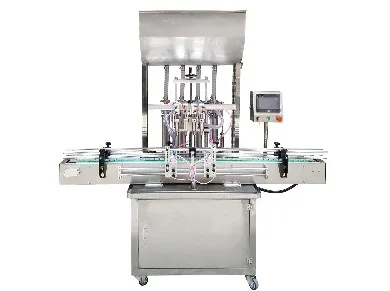
Servo-controlled filling can support repeatability, recipe changes and automatic operation where production teams need consistent fills across batches.
Buyer intent guide
The right filling machinery recommendation comes from the product, container and output target together. Lancing can compare semi-automatic, compact and fully automatic options once those details are clear.
Viscosity, foam, particles, temperature and chemical compatibility.
Bottle, jar, pail or jerrycan size, neck opening, stability and closure.
Fill volume or weight, accuracy tolerance and required bottles or packs per minute.
Manual loading, semi-automatic operation, compact automation or full inline production.
Specification notes
These points help make an enquiry more accurate and reduce the risk of selecting the wrong filling principle.
The same bottle filling machine can perform very differently when the liquid changes. A water-thin cleaner, a foaming detergent, a viscous sauce, a fragrance oil and a corrosive chemical each create different challenges. Product behaviour drives pump selection, nozzle design, materials and speed.
For a strong recommendation, include the product type, approximate viscosity, whether it foams or strings, whether it contains particles and whether it needs heating, mixing or special materials.
Filling speed should be balanced with capping, labelling, operator loading and packing. A fast filler does not improve the line if bottles cannot be presented, capped or labelled at the same rate.
For growing production, Lancing can discuss a sensible route from semi-automatic equipment to compact automation or a fully automatic filling line.
Relevant machinery
These product pages are useful starting points when discussing servo filling machine UK.
Relevant Lancing machinery to discuss when specifying servo filling machine UK projects.
View productRelevant Lancing machinery to discuss when specifying servo filling machine UK projects.
View productRelevant Lancing machinery to discuss when specifying servo filling machine UK projects.
View productRelevant Lancing machinery to discuss when specifying servo filling machine UK projects.
View productFAQs
Send the product name, viscosity or sample details, fill volume, container dimensions, closure type, required output, cleaning needs and any safety or material compatibility requirements.
Yes. Lancing can discuss semi-automatic, compact and fully automatic configurations depending on output target, product behaviour, budget and future production plans.
The correct method depends on viscosity, foaming, particles, fill range, container type, accuracy requirement and production speed. A short specification review is usually the safest way to narrow the options.
Related guides
Need a recommendation?
Lancing will recommend a suitable semi-automatic, compact or fully automatic filling solution.
Controlled motion and recipes
Servo drives can provide repeatable control of pump, piston or nozzle motion and allow recipes to store position, speed and acceleration settings. That flexibility is valuable when the underlying product path, feed condition and container handling have already been engineered. A servo cannot compensate for air entering the supply, an unsuitable pump, blocked valves or an unstable bottle.
The specification should identify which axes are servo controlled, what each recipe contains, how limits are protected and how the machine returns to a known state after a stop. Where nozzles track moving containers, conveyor position, bottle pitch and anti-collision logic become part of the dosing process.
Acceleration, constant-speed movement, deceleration and reversal can shape the product flow and end-of-fill response. Develop profiles with the real product and record them as recipes with controlled access to critical limits.
A travelling nozzle can fill while the container moves, but tracking must remain aligned with the neck across conveyor speed and pack variation. Test start, stop, gaps and recovery, not only continuous running.
Store product and pack settings with clear names, revision control and verification steps. A recipe change may still require physical nozzles, guides, hoses or calibration, so the HMI should not imply a purely software changeover.
Specification and trial evidence
The test should connect motion control to actual liquid and container results.
| Selection point | What to define or test | Why it matters |
|---|---|---|
| Axis purpose | Pump, piston, nozzle lift, nozzle tracking or container handling | Defines the controlled variable and its safety limits. |
| Reference and limits | Homing method, travel limits, protected parameters and manual modes | Prevents loss of position or unsafe recovery after intervention. |
| Product profile | Speeds, acceleration, deceleration and suck-back for each liquid | Links motion settings to foam, splash, drip and cycle time. |
| Container tracking | Pitch, conveyor encoder, neck tolerance and gap handling | Keeps moving nozzles aligned without contact. |
| Head verification | Individual calibration and combined multi-head sample checks | Confirms that common motion control produces acceptable results at every head. |
| Fault recovery | Power loss, emergency stop, blocked line, missing container and axis fault | Ensures the machine restarts without double filling or losing container identity. |
Buyer questions
It can provide programmable, repeatable motion for dosing and nozzle axes, supporting controlled acceleration, deceleration and recipes. The benefit depends on a suitable pump, product feed and mechanical arrangement.
Not by itself. Accuracy also depends on metering principle, product condition, air, valves, nozzle shut-off, calibration and measurement. Servo control improves motion repeatability but must be validated as part of the process.
It is a nozzle that travels with a moving container during filling. This can reduce stop-and-index time, but requires synchronised conveyor position, pack spacing and anti-collision control.
Recipes can change stored positions and speeds, but guides, nozzles, sensors and change parts may still need physical adjustment. Verify each format before production.
The machine should stop in a defined state, identify the affected containers and require an appropriate reset or homing sequence. Recovery should be demonstrated during acceptance testing.
Provide viscosity across the filling temperature range, foaming, solids, fill volume, target output and nozzle behaviour, plus the source arrangement and container samples.
Servo control architecture
The word “servo” describes a controlled motion axis, not one universal filling principle. A machine may use servo position for a piston stroke, servo rotation for a pump, synchronised motion for a following nozzle, or a combination of these functions.
Define each axis in the specification and link it to the process result it is intended to control. Dose accuracy still depends on product supply, air exclusion, valve behaviour, tube or seal condition and the calibration method. Nozzle tracking still depends on container pitch, conveyor feedback and reliable bottle detection.
A recipe should therefore store only settings that have been proven for the named product, fill and container. Protect engineering parameters separately from routine operator adjustments, and record the approved product condition and change parts alongside the numeric recipe.
Confirm the relationship between commanded motion and delivered product. Check backlash, slip, valve timing, pressure and refill conditions at the minimum and maximum approved doses.
Define the start height, immersion, following profile, end position and clearance from the container. Prove the profile with the actual foam, splash or stringing behaviour.
Verify how container position is detected and how tracking responds to speed change, slip, missing packs and a stopped downstream machine. Recovery should not depend on an uncertain bottle state.
Parameter verification
| Servo or recipe setting | Process influence | Acceptance check |
|---|---|---|
| Target position or revolutions | Nominal displaced volume or pump movement | Measure consecutive fills at the defined product condition and retain the calibration reference. |
| Acceleration and deceleration | Product pressure, splash, foam and mechanical load | Inspect pack cleanliness and fill stability at normal running and after a restart. |
| Fast/slow transition | Bulk-fill time and control near the target | Confirm the transition does not aerate the product or extend the cycle without benefit. |
| Reverse or suck-back | Residual pressure, nozzle tail and delayed drip | Check repeated cycles and a representative pause; excessive reverse action must not draw air into the product path. |
| Following-nozzle profile | Nozzle position relative to the rising liquid and moving container | Verify clearance, tracking and clean withdrawal across conveyor speed and pack variation. |
| Recipe permissions | Control of approved settings and unauthorised change | Test operator, supervisor and engineering access together with recipe identification and change records. |
| Reference and fault recovery | Known machine position after stop, alarm or power interruption | Demonstrate a controlled recovery that identifies any container or dose requiring rejection. |