
4 filling heads
Compact footprint with strong throughput.
Automatic filling machines
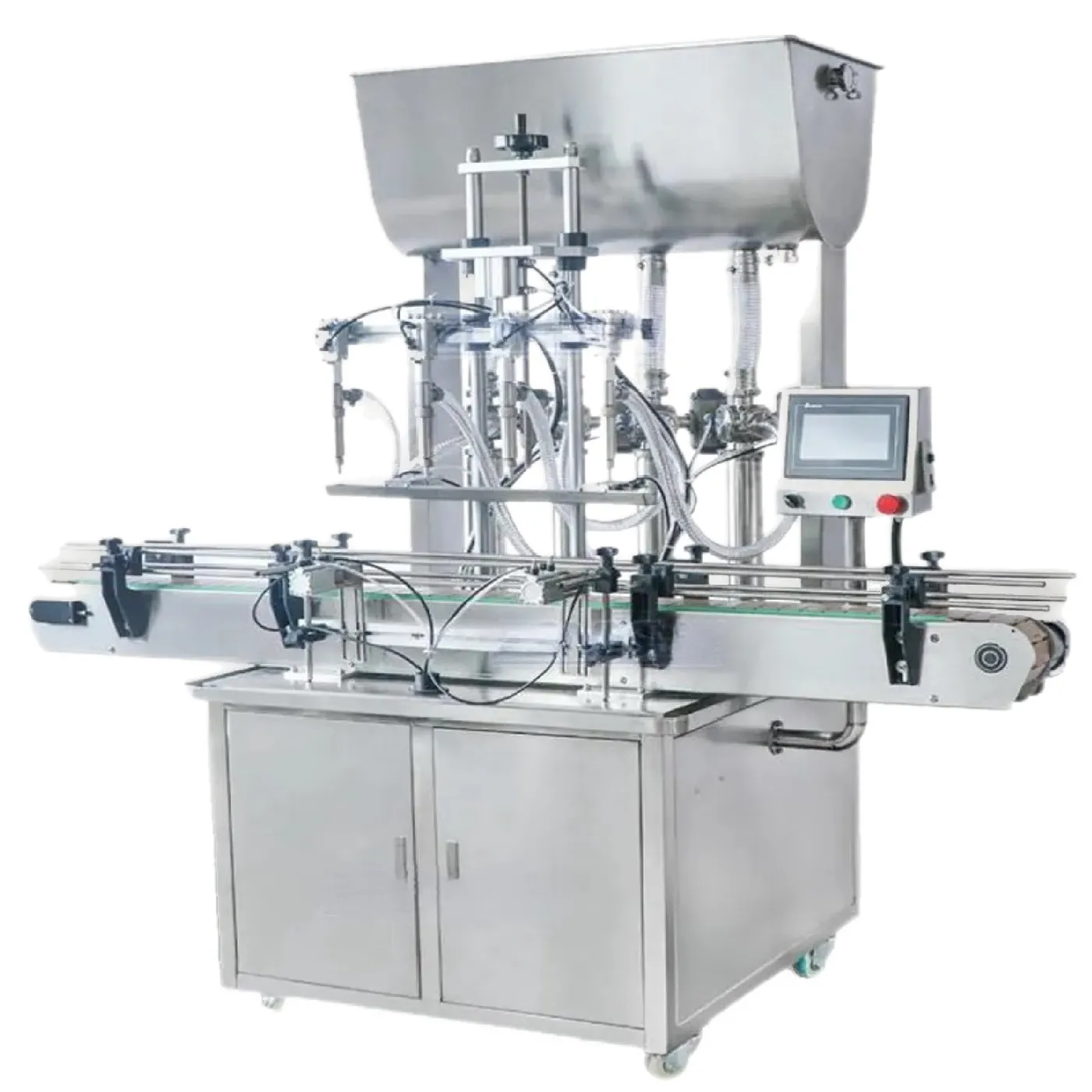
Four‑nozzle automatic piston filler for honey, sauce, cream and lotion. Choose the appropriate cylinder module for your fill size.
Key features
Compact footprint with strong throughput.
5–100 / 10–300 / 50–500 / 100–1000 / 500–3000 / 1000–5000 ml.
Clean finishes and less rework.
Simple numeric volume entry.
Reliable auto cycle and less spillage.
Food/beauty friendly surfaces.
Technical information
Performance varies by product, container and setup. Ask for a timed trial or specification review.
| Head count | 4 |
|---|---|
| Volume modules | 5–100 to 1000–5000 ml |
| Method | Piston volumetric |
| Accuracy | ≤±1% (ref.) |
| Media | Paste and liquids |
| Options | Heated hopper, mixer |
| Voltage | 110/220 V, 50–60 Hz |
| Air | 0.4–0.7 MPa typical |
| Conveyor | Integrated chain conveyor |
| Controls | Touchscreen HMI + sensors |
| Materials | Stainless steel contact parts |
| Cleanability | Tool‑less disassembly |
Applications
Honey, sauces, condiments.
Creams, lotions.
Detergents and gels.
What is included
Related products
Automatic filling machines
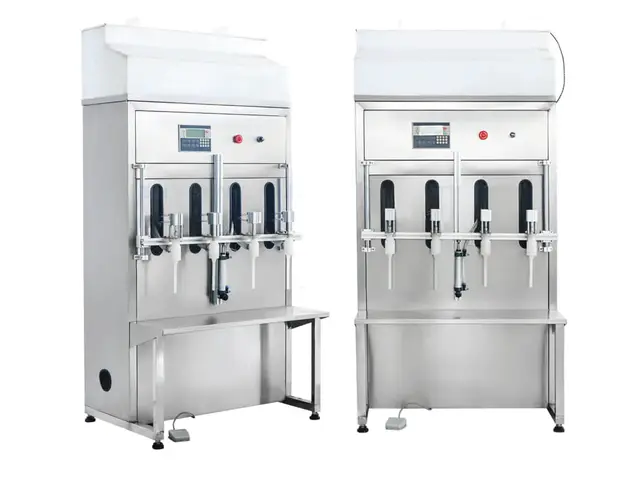
Automatic gravity filler engineered for corrosive liquids like bleach, acids and fertilizers. Non‑metal wetted parts (PP/PTFE/PVC)…
View details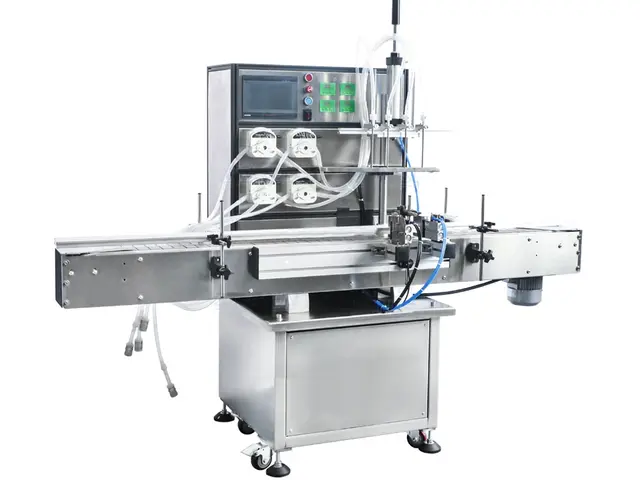
Automatic filling machines
Automatic 4‑head diaphragm‑pump filler for gels, shampoo and detergents. Large 40 L/min flow rate supports ≈30–45 bpm with four…
View details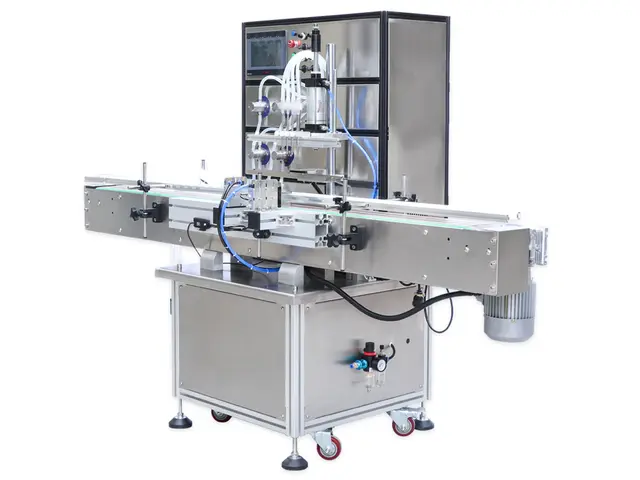
Automatic filling machines
Equipped with a gear pump, this liquid filling machine can work automatically. The machine can fill about 30 bottles/min (at 5L). Each…
View detailsApplication and acceptance guidance
This machine uses a piston-volumetric method with four filling heads. It is a candidate for liquids and pastes where positive displacement and controlled nozzle shut-off are appropriate. Final suitability depends on how consistently the product enters each cylinder, whether valves and nozzles pass the product, and whether the selected volume module covers the required fills without impractical stroke settings.
The product trial should use the intended hopper or feed arrangement and the actual container. Test the lowest and highest required fills, the most viscous product condition and any particles or aeration. Record each head separately so a combined average cannot conceal a head that needs different adjustment or maintenance.
Compare minimum, normal and maximum fills with the existing module choices shown on this page. Confirm calibration sensitivity, suction and discharge time at both ends of the range. A different module may be preferable when one application spans widely separated quantities.
Viscous products may need a controlled hopper level, agitation, temperature management or an assisted feed. Record those conditions in the recipe or operating method so the cylinders refill consistently as the batch progresses.
Use the anti-drip arrangement with a fill profile suited to splash, foam or product strings. Check nozzle clearance, shut-off, any suck-back and the cleanliness of the neck and container exterior after repeated fills and stops.
Specification and trial evidence
The published specification remains subject to product, pack and setup. The following trial sequence connects it to the intended application.
| Selection point | What to define or test | Why it matters |
|---|---|---|
| Prime and balance | Prime all product paths and confirm no trapped air before calibration | Creates a comparable starting condition for all four heads. |
| Calibrate each head | Measure a consecutive sample from every nozzle using the agreed method | Identifies head-to-head bias before assessing combined output. |
| Test fill range | Run minimum, normal and maximum required quantities | Confirms the selected cylinder module remains practical throughout the application. |
| Challenge product | Use the coldest or most viscous approved condition and representative particles | Tests valve passage, cylinder refill and cycle time. |
| Stop and restart | Pause with product in the circuit, then restart using the normal sequence | Reveals delayed drip, settling and restart variation. |
| Clean and reassemble | Complete the proposed clean-down and verify the first approved fills afterward | Confirms changeover access and restoration of the validated setup. |
Buyer questions
Provide the most viscous approved condition, the thinnest product if the same machine will fill both, and any representative particles. Include enough product for priming, repeated fills and cleaning observations.
Each head should be measured individually, adjusted as required and then checked in the combined production sequence. Retain the product condition, settings and results.
That depends on the stated range and the practical stroke at the minimum and maximum. Compare module or change-part options where the required range is wide.
Product temperature, suction path, hopper level, piston speed, valve passage, nozzle diameter and dose all contribute. The intended feed arrangement should be used in the trial.
Positive nozzle shut-off, controlled end speed, suck-back where appropriate and nozzle withdrawal timing can help. Tune with repeated fills and line stops.
Keep individual head results, target and tolerance, measurement instrument, product temperature, container, recipe, operating state and reasons for any rejected fills.
Machine demonstration
The video provides a visual reference for the filling station. Final performance must still be established with the intended liquid, cylinder module, container and agreed test method.
Confirm that every bottle is centred before nozzle movement, that each head begins and ends cleanly, and that the product does not remain on the neck or outside of the container. Measure each nozzle separately after the product circuit has been fully primed.
Repeat the observation after a normal line stop. Nozzle tails, delayed drips, trapped air and head-to-head imbalance are often easier to identify during restart than in a short uninterrupted cycle.
Bottles are indexed beneath four filling nozzles. The nozzles descend to the bottle openings, product is dispensed through the four heads, and the filling station completes the cycle with the bottles retained on the conveyor.
Technical guidance
Use controlled product, feed and measurement evidence.
Prove cylinder range, product feed, nozzle and pack behaviour.
Read guideStabilise source level, temperature and refill conditions.
Read guideMeasure individual heads and separate bias from spread.
Read guideReview cylinder, valves, seals, hoses and nozzles.
Read guide