
Why use piston or volumetric filling
A measured chamber or cylinder delivers a controlled volume. This makes the method useful for products where consistent fill quantity is important and the product can be drawn and discharged repeatably.
Piston and volumetric fillers
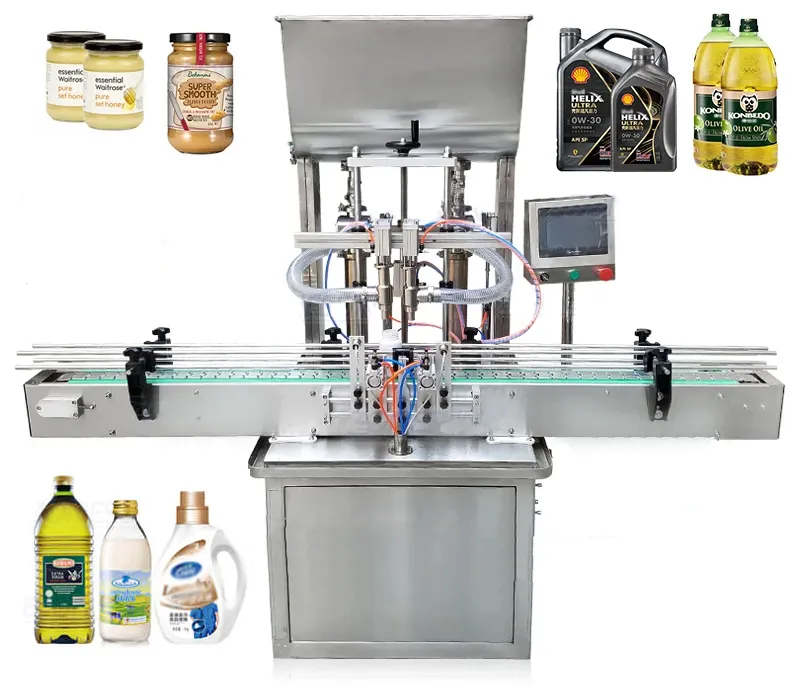
Piston and volumetric filling machines are used where a repeatable fill volume is required across liquids, creams, gels and sauces. They can be configured for semi-automatic production or integrated into automatic lines.
Specification guide
These notes are written for buyers comparing filling machinery options before requesting a quotation.
A measured chamber or cylinder delivers a controlled volume. This makes the method useful for products where consistent fill quantity is important and the product can be drawn and discharged repeatably.
Food sauces, honey, shampoo, creams, lotions, gels, oils and compatible chemical products are common applications. Product texture, particulates and temperature should be reviewed before selection.
Cylinder size, nozzle design, hopper or tank feed, air supply, product temperature and clean-down requirements determine the final machine layout.
Key considerations
Measured volume supports consistent filling.
Cylinder modules can be chosen around the required fill volume.
Suitable configurations can handle many viscous liquids.
The same filling principle can support different automation levels.
Relevant machines
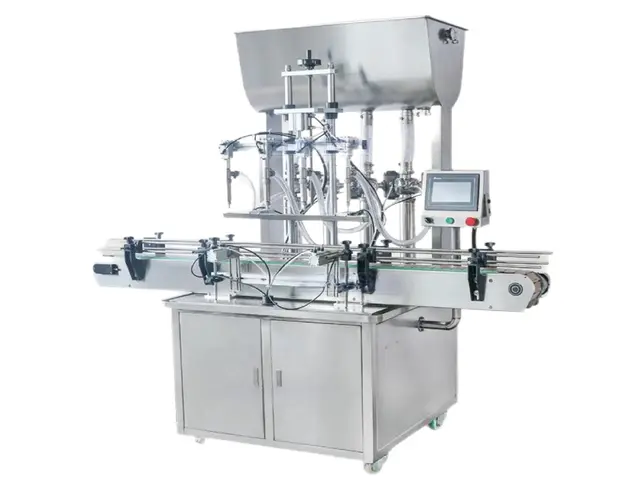
Automatic filling machines
Four‑nozzle automatic piston filler for honey, sauce, cream and lotion. Choose the appropriate cylinder module for your fill size.
View details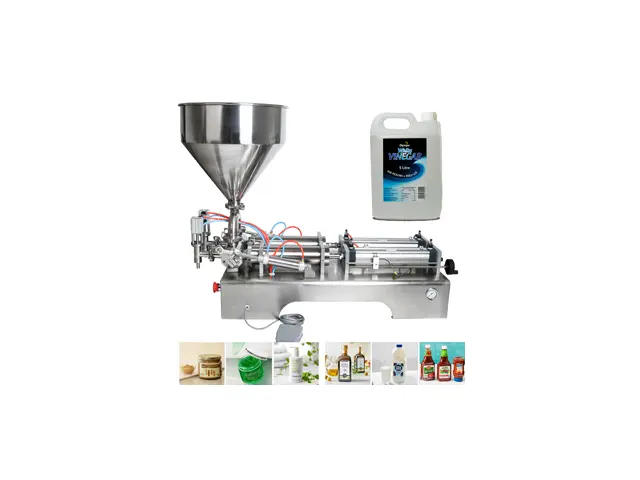
Semi-automatic filling machines
The semi-automatic system offers separate machines each requiring manual product placement but still affording a very significant improvement in production rates compared to manual…
View details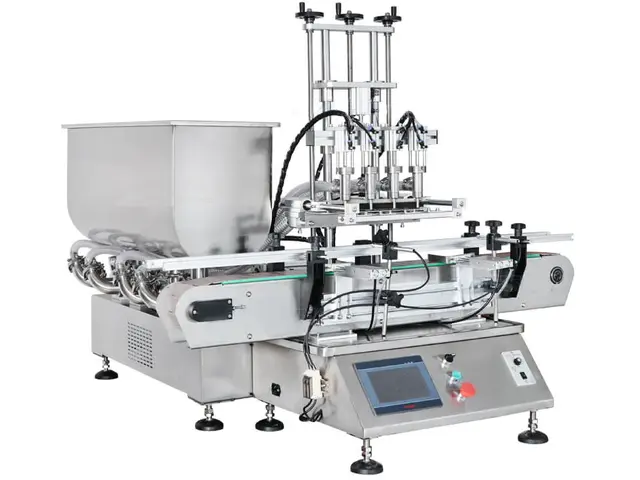
Compact filling machines
Tabletop 2–4 head piston filler for soaps, shampoos and viscous liquids. Accurate volumetric dosing with ≤±1% typical accuracy.
View details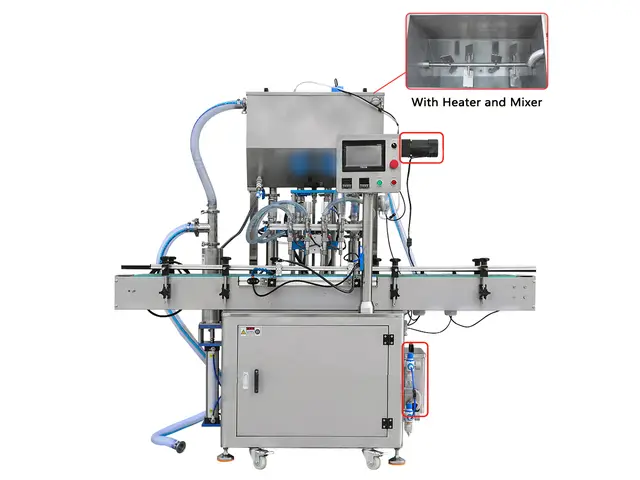
Paste and viscous filling machines
Six‑nozzle automatic piston filler for viscous products like cream, pesto or béchamel. Select a cylinder module (5–100 to 1000–5000 ml) and run precise volumetric fills.
View details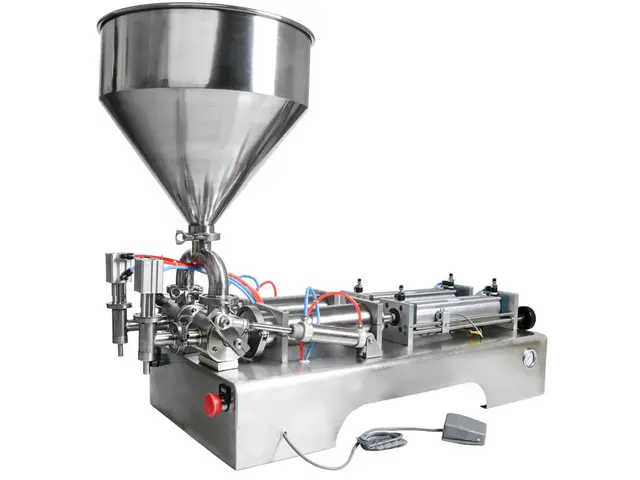
Semi-automatic filling machines
Pneumatic twin‑head piston filler with hopper. Select a cylinder module from 10–100 ml up to 1000–5000 ml to suit your dose.
View details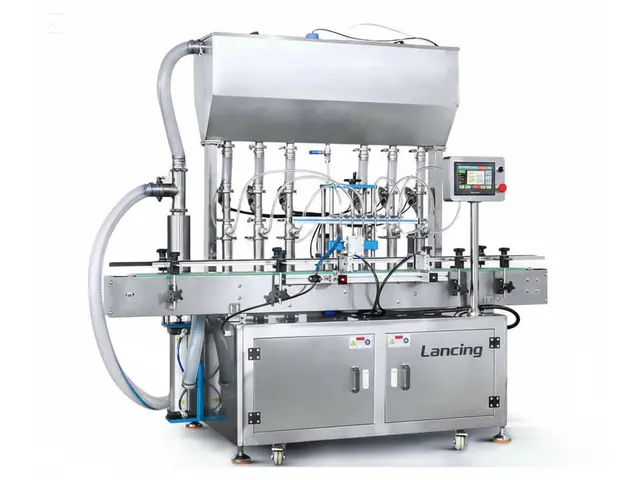
Paste and viscous filling machines
Paste and viscous liquid filling machinery for creams, gels, sauces, honey, cosmetics, adhesives and thick household products.
View detailsRelated guides
FAQ
A volumetric filler delivers a measured volume of product, typically using a chamber, piston or controlled dosing system.
Yes, many sauces suit piston filling if particulates, temperature and viscosity are within the machine specification.
They can be very repeatable when correctly sized and set up for the product and container.
Speak to Lancing
Tell us the liquid, container, fill range and target output. Lancing will recommend a practical semi-automatic, compact or fully automatic option.
Positive-displacement filling
A piston filler draws product into a measured cylinder and then displaces it to the container. This positive-displacement principle can suit viscous liquids, creams, sauces, gels and pastes where repeatable volumes and larger product passages are useful. The cylinder alone does not define suitability: inlet and outlet valves, ports, seals, hopper or feed pressure and nozzle must all pass the product reliably.
The selected cylinder should place the normal fill range within a practical part of its stroke while maintaining acceptable cycle time and adjustment. If one machine must cover widely separated fill volumes, compare the change parts, calibration and cleaning implications rather than assuming the largest cylinder is the best universal choice.
Choose the cylinder module around minimum, normal and maximum fills. Very short strokes can make small adjustments more sensitive, while a very large dose can lengthen suction and discharge time. Confirm results across the whole required range.
The largest particle and the product around it must pass the inlet, changeover valve, outlet, hose and nozzle. Test representative solids distribution and check whether valves can close without crushing product or holding residue.
A hopper, heated vessel, mixer or pumped feed may be needed to keep viscous product consistent. Record temperature, agitation and source level because they affect suction, trapped air and the time required to refill the cylinder.
Specification and trial evidence
The test should prove product flow and clean-down as well as the measured dose.
| Selection point | What to define or test | Why it matters |
|---|---|---|
| Dose range | Minimum, normal and maximum target with accepted tolerance | Confirms cylinder sizing and adjustment sensitivity. |
| Product state | Temperature, viscosity, particles, aeration and time at rest | Defines suction, valve and nozzle behaviour. |
| Feed arrangement | Hopper size, level, agitation, heating or external pump pressure | Maintains consistent cylinder filling throughout the batch. |
| Nozzle action | Opening, shut-off, suck-back, diving and distance to product surface | Controls splash, stringing and pack cleanliness. |
| Cleaning | Drain, strip-down, seals, dead areas, cleaning agent and reassembly check | Determines changeover time and whether the required procedure is practical. |
| Acceptance | Instrument, density if converting, sample count, start-up and steady-state checks | Creates a traceable basis for fill accuracy and repeatability. |
Buyer questions
Viscous liquids, creams, sauces, gels and many pastes can be candidates, subject to particles, temperature, shear, valves, materials and cleaning. The actual product should be assessed.
Only if the complete product path and valves can pass the largest representative piece without blockage or damage. Particle size, shape, concentration and settling should be included in the trial.
The displaced volume is adjusted through piston stroke or the machine’s control arrangement. Different cylinder modules or parts may be needed for a very wide range, and each setup should be verified.
Agitation, product folding, suction speed, hopper refill and valve movement can introduce or retain air. Product preparation and a controlled draw profile may be as important as the filler setting.
A shut-off nozzle, suck-back, suitable orifice, controlled deceleration and nozzle movement can help. The best combination depends on product elasticity and fill height.
Confirm correct assembly, seal condition, valve orientation, prime, absence of leaks, calibration and the first approved fills before returning to production.
Buyer questions
Piston displacement is only one part of the volumetric filling result.
A piston filler draws product into a cylinder and displaces a controlled volume during the delivery stroke. The selected stroke establishes the nominal volume, while valve timing, cylinder fill, seals, product condition and nozzle shut-off affect the delivered result. Calibration should be carried out with the actual product and production feed conditions.
A check valve must seat, open and close consistently so the cylinder fills from the source and discharges to the nozzle without backflow. Product particles, strings, viscosity, wear or contamination can delay or prevent seating. The result may be alternating or drifting fills even when the piston stroke remains unchanged.
Provide representative particle size, shape, concentration and settling behaviour, then review every clearance through the pickup, valves, cylinder, hose and nozzle. Inspect particle condition and distribution in finished packs as well as total quantity. The particle-filling guide sets out the evidence needed.
Confirm the correct seal material and orientation, inspect the cylinder and product path, complete the defined cleaning and lubrication procedure where applicable, then prime and check for leakage or air. Recalibrate and compare sequential fills, including the first packs after restart. Do not assume a mechanically successful seal change preserves the previous dose automatically.
Piston filling checks
Piston filling can handle many viscous and structured products, but product condition, seal compatibility, feed pressure and nozzle design must be assessed as one system.
Temperature can change viscosity, entrained air, flow into the measuring chamber and nozzle cut-off. A product that fills consistently when warm may load slowly or string when cool. The trial should therefore cover realistic minimum, normal and maximum temperatures and reproduce the intended product-feed route.
Piston-filler wear depends on product abrasiveness, particles, chemistry, temperature, pressure, cleaning method and operating frequency. Seal and valve materials must suit the product-contact conditions. Preventive inspection should look for leakage, scoring, delayed valve action and fill drift, with the correct verified parts held for the supplied configuration.
Residual product may remain in the feed vessel or pipe, measuring cylinder, valves, manifold and nozzles. The amount depends on layout, drainage and the end-of-batch method. Acceptance should distinguish normal system hold-up from avoidable loss and state whether dismantling, product push-through or recovery is permitted.
A piston filler may suit structured products because it can move a defined volume through a comparatively open path, but valve geometry, speed, product feed and nozzle restrictions can still affect texture or inclusions. The actual product should be trialled, including the largest expected particles and the full temperature range, before suitability is confirmed.