
Following nozzles
Nozzles follow bottles as they move, increasing throughput.
Automatic filling machines
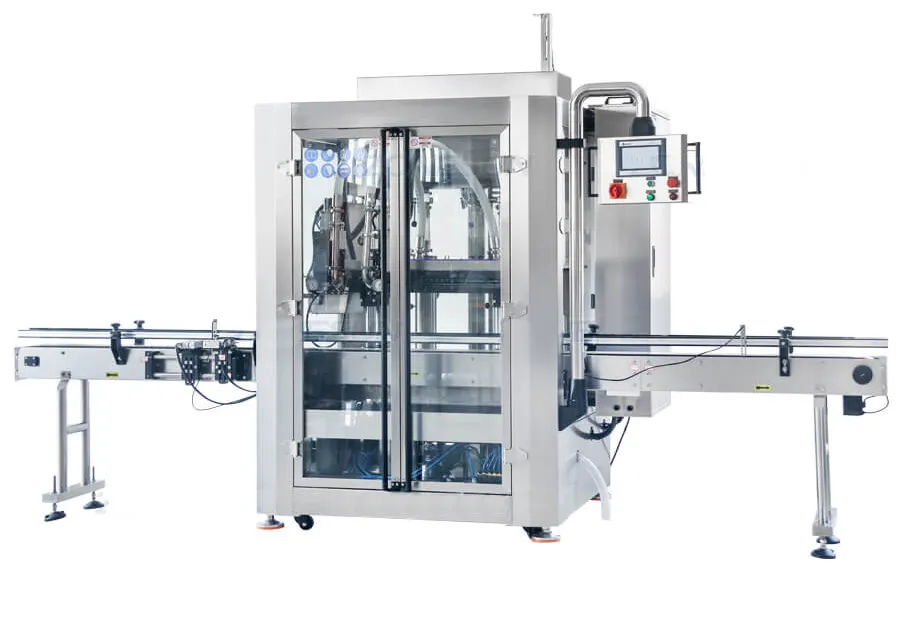
High‑speed servo piston filler with following nozzles that track bottles on the move. Set volume directly on the touchscreen; electric‑eye detection and a feeding pump help maintain accuracy at speed (≈40–80 bpm).
Key features
Nozzles follow bottles as they move, increasing throughput.
Enter the volume on the HMI—no timing required.
5–100 / 10–300 / 50–500 / 100–1000 ml modules.
Ø30–100 mm by 40–250 mm height.
Real‑time parameters; multi‑language UI.
Large‑flow gear pump supplies product to the filler.
Technical information
Performance varies by product, container and setup. Ask for a timed trial or specification review.
| Model | LUSV6X |
|---|---|
| Pump type | Piston (servo‑driven) |
| Volume modules | 5–100 / 10–300 / 50–500 / 100–1000 ml |
| Working speed | ≈40–80 bottles/min (product‑dependent) |
| Bottle diameter | ≈30–100 mm |
| Bottle height | ≈40–250 mm |
| Voltage | 110/220 V, 50–60 Hz |
| Power | ≈6 kW |
| Machine size (pkg.) | ≈2210 × 1260 × 2220 mm |
| Package weight | ≈950 kg |
| Nozzle count | Customisable multiple heads |
| Controls | Touchscreen + electric eye |
Applications
Honey, peanut butter, ketchup, juices.
Shampoo, gels, creams.
Detergents and cleaners.
What is included
Related products
Automatic filling machines
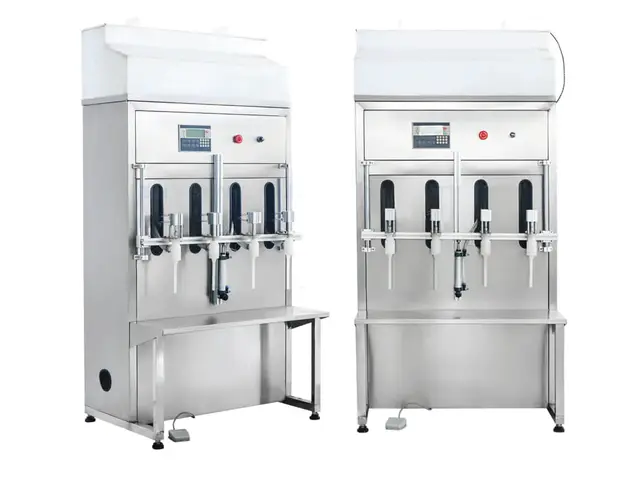
Automatic gravity filler engineered for corrosive liquids like bleach, acids and fertilizers. Non‑metal wetted parts (PP/PTFE/PVC)…
View details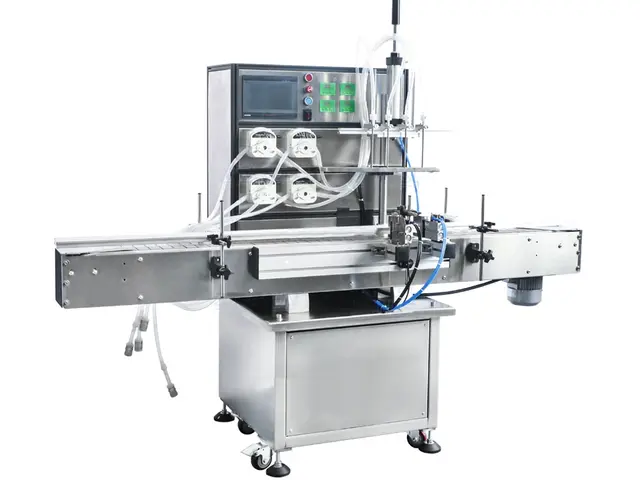
Automatic filling machines
Automatic 4‑head diaphragm‑pump filler for gels, shampoo and detergents. Large 40 L/min flow rate supports ≈30–45 bpm with four…
View details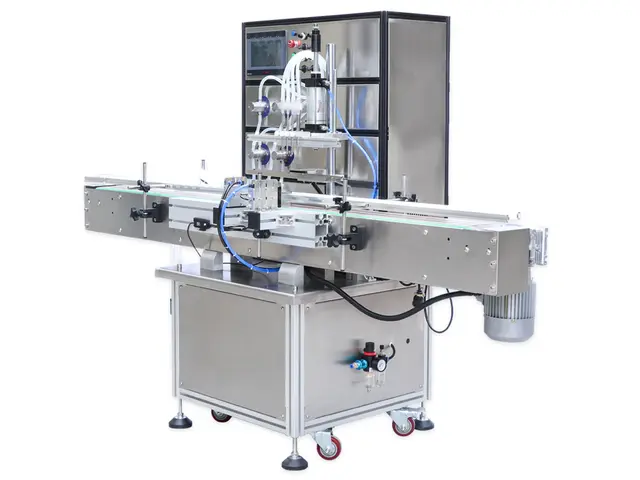
Automatic filling machines
Equipped with a gear pump, this liquid filling machine can work automatically. The machine can fill about 30 bottles/min (at 5L). Each…
View detailsApplication and acceptance guidance
This automatic servo piston machine uses programmable dosing motion and following nozzles intended to track containers through the fill. The existing specification identifies a product-dependent working-speed range. Usable output depends on stable product supply, cylinder or pump configuration, bottle pitch, conveyor feedback and the time needed for a clean end of fill.
The acceptance test should include continuous operation and deliberate gaps, line stops and restarts. A following nozzle must stay aligned with the neck without contact when bottle spacing varies within the agreed range. Suspect packs created during a fault should be identifiable and handled through a defined recovery sequence.
Develop servo speed, acceleration and deceleration with the actual liquid. Thick, foaming or stringing products may require a different profile from water even when the fill volume is the same.
Confirm conveyor encoder or position feedback, bottle pitch, neck tolerance and guide setup. Test missing bottles and normal spacing variation so nozzles do not chase an invalid position.
Document the physical change parts and verification steps linked to each recipe. Demonstrate power-up, emergency stop, blocked downstream line and axis-fault recovery without double filling.
Specification and trial evidence
The machine should be assessed as a controlled moving process rather than only as a stationary dose test.
| Selection point | What to define or test | Why it matters |
|---|---|---|
| Static dose check | Verify each head at controlled conveyor and product conditions | Establishes metering before adding tracking variables. |
| Tracking run | Operate at agreed pack pitch and speed using production containers | Confirms neck alignment and following motion. |
| Gap handling | Introduce agreed empty positions or irregular spacing | Tests no-bottle-no-fill and tracking reset. |
| Blocked line | Create a safe downstream blocked condition and recover | Checks stop sequencing and container identity. |
| Product challenge | Use worst approved viscosity and source condition | Confirms profile, feed and cycle time. |
| Format change | Change recipe and physical guides or nozzles, then reapprove | Measures changeover and prevents recipe-only assumptions. |
Buyer questions
They move in synchronisation with bottles on the conveyor during the fill. This can reduce indexing time, but requires controlled spacing, position feedback and anti-collision logic.
The HMI and servo control the programmed motion, while the actual result also depends on the selected piston or pump arrangement, product condition, valves and nozzle.
Potentially within the stated machine window, subject to guides, nozzles, sensors, tracking positions and stability. Every format needs a documented setup and approval check.
Use an agreed acceptance plan to simulate missing bottles, blocked line, emergency stop and axis faults without creating an unsafe condition. Record the recovery and disposition of affected packs.
Fill time, number of heads, tracking stroke, bottle pitch, product feed and downstream operations all contribute. The slowest sustainable condition controls good output.
Provide sufficient product for priming and a sustained run at normal and worst approved temperature, together with production bottles and closures.
Technical guidance
Prove the controlled axis as part of the product and line process.
Keep source conditions stable while motion and dose settings are tested.
Read guideConfirm tracking, nozzle clearance and recovery after line stops.
Read guideTest recipes, motion, safety and integrated operating conditions.
Read guideCoordinate speed reference, pack tracking and downstream equipment.
Read guide