
Product behaviour
Viscosity, foam, particles, temperature and chemical compatibility.
Selection and comparison guides
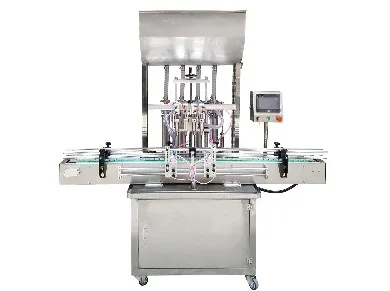
A filler’s speed is not just the pump rate. Bottle presentation, nozzle count, fill accuracy, foam control, capping and labelling can all become the limiting step.
Buyer intent guide
The best choice is rarely decided by one factor. A method that works well for a thin chemical may not suit a viscous food product, and a machine that is fast on one bottle format may slow down when changeovers are frequent.
Viscosity, foam, particles, temperature and chemical compatibility.
Bottle, jar, pail or jerrycan size, neck opening, stability and closure.
Fill volume or weight, accuracy tolerance and required bottles or packs per minute.
Manual loading, semi-automatic operation, compact automation or full inline production.
Specification notes
These points help make an enquiry more accurate and reduce the risk of selecting the wrong filling principle.
The same bottle filling machine can perform very differently when the liquid changes. A water-thin cleaner, a foaming detergent, a viscous sauce, a fragrance oil and a corrosive chemical each create different challenges. Product behaviour drives pump selection, nozzle design, materials and speed.
For a strong recommendation, include the product type, approximate viscosity, whether it foams or strings, whether it contains particles and whether it needs heating, mixing or special materials.
Filling speed should be balanced with capping, labelling, operator loading and packing. A fast filler does not improve the line if bottles cannot be presented, capped or labelled at the same rate.
For growing production, Lancing can discuss a sensible route from semi-automatic equipment to compact automation or a fully automatic filling line.
Relevant machinery
These product pages are useful starting points when discussing filling machine output speed.
Relevant Lancing machinery to discuss when specifying filling machine output speed projects.
View productRelevant Lancing machinery to discuss when specifying filling machine output speed projects.
View productRelevant Lancing machinery to discuss when specifying filling machine output speed projects.
View productRelevant Lancing machinery to discuss when specifying filling machine output speed projects.
View productFAQs
Send the product name, viscosity or sample details, fill volume, container dimensions, closure type, required output, cleaning needs and any safety or material compatibility requirements.
Yes. Lancing can discuss semi-automatic, compact and fully automatic configurations depending on output target, product behaviour, budget and future production plans.
The correct method depends on viscosity, foaming, particles, fill range, container type, accuracy requirement and production speed. A short specification review is usually the safest way to narrow the options.
Related guides
Need a recommendation?
Lancing will recommend a suitable semi-automatic, compact or fully automatic filling solution.
Good finished packs, not theoretical cycles
A filling cycle can be estimated from product flow and dose, but a production figure must also include container indexing, nozzle movement, settling, cap application, labelling, sample checks, product replenishment and routine stops. The slowest sustained operation controls the line, and short interruptions can dominate a small batch.
Use two linked measures: good packs per minute during a defined stable run, and good packs per shift or batch after planned losses. Record rejects and reasons rather than counting every container that passes the filler. This prevents a nominal machine rate being mistaken for saleable output.
Break the machine cycle into index or presentation, nozzle movement, bulk fill, final fill, shut-off, settling and release. Identify which activities overlap and which are sequential. Confirm the model with the actual product and pack.
Compare filler, capper, labeller, coder, inspection and packing capacity under the same pack and operating assumptions. Provide accumulation or control logic for short-term differences rather than sizing every machine to an unrelated maximum.
Include product refill, roll or cap replenishment, samples, cleaning, changeover, breaks, minor faults and start-up approval. These losses determine whether a line meets the required daily or weekly volume.
Specification and trial evidence
State the time basis and assumptions next to every rate so the figure can be verified later.
| Selection point | What to define or test | Why it matters |
|---|---|---|
| Fill time | Dose divided by proven product flow, including bulk and fine stages | Sets the core dosing time under stated liquid conditions. |
| Mechanical time | Index, nozzle motion, bottle release and required settling | Adds non-filling portions of the machine cycle. |
| Parallel heads | Number of active heads and any head-balancing constraint | Converts cycle rate into potential container rate. |
| Line constraint | Slowest connected operation at the same product and pack | Defines sustainable line output. |
| Planned losses | Refill, consumables, sampling, cleaning, changeover and breaks | Converts running rate into shift capacity. |
| Unplanned losses | Minor stops, pack jams, faults and reject recovery | Supports a realistic performance allowance after evidence exists. |
| Good output | Accepted packs after rejects over the agreed period | Provides the commercial result that should be compared with demand. |
Buyer questions
It should mean accepted containers produced in one minute under stated product, fill, pack and operating conditions. Ask whether it is theoretical, observed filler output or finished line output.
Only if product supply, filling time, indexing and downstream equipment can support them. Head calibration and container spacing also have to remain stable.
Less product usually reduces dosing time, but mechanical movement and downstream operations remain. At some point those fixed activities become the cycle constraint.
Measure from the last approved pack of one format to the first approved pack of the next, including cleaning, parts, recipe, calibration and quality release.
It uses representative product and packs for an agreed period, records stoppages and rejects, and includes any required sample checks. The duration should be sufficient to expose normal product replenishment or line interaction where relevant.
Use the proven or conservatively estimated stable rate, batch size, planned refill and changeover, staffing and known line constraints. Keep assumptions visible and update them with real production data.
Technical guidance
The filler cycle must be supported by product supply and pack flow.
Prove starts, stops, transfers and accumulation with real packs.
Read guideInclude refill, low-level and temperature conditions in timed runs.
Read guideMeasure good finished packs through the complete sequence.
Read guideDefine the timed-run start, finish, stops and evidence.
Read guide