
Clean product path
Liquid only contacts the tubing for fast changeovers.
Compact filling machines
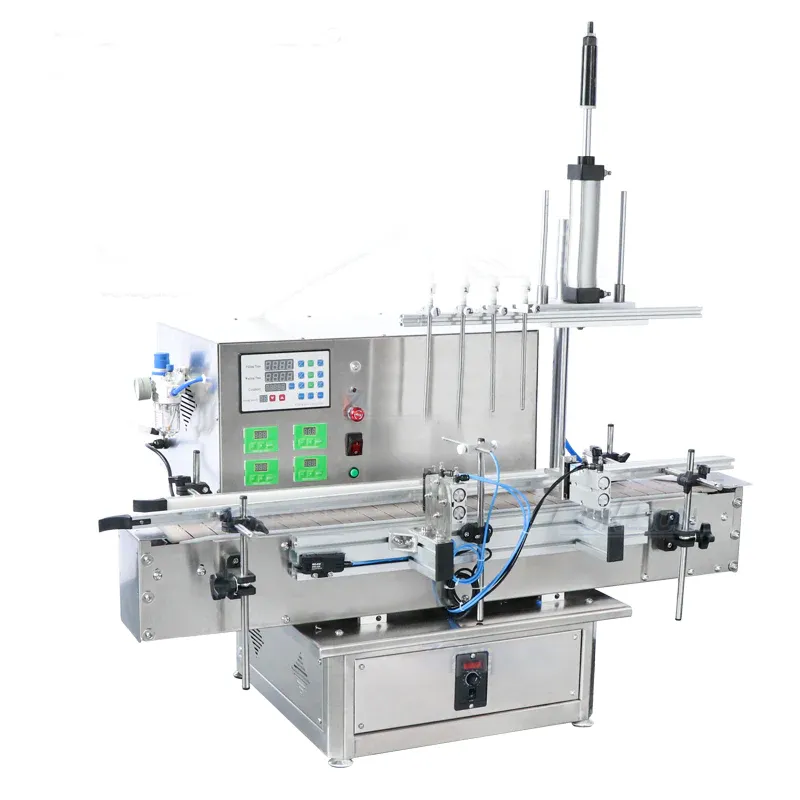
Desktop automatic peristaltic filler with 4 nozzles. Each head has an independent pump (≈60 W) delivering up to ≈4000 ml/min; ≈30–50 bpm depending on bottle and liquid.
Key features
Liquid only contacts the tubing for fast changeovers.
Fill different products or volumes per channel (if needed).
Up to ≈4000 ml/min per nozzle (water) and ≈30–50 bpm.
Accurate bottle detection for auto cycle.
≈650 × 430 × 400 mm; ≈55.5 kg.
≈1.0 m belt with smooth transfer.
Technical information
Performance varies by product, container and setup. Ask for a timed trial or specification review.
| Model | LUDTPP4F |
|---|---|
| Nozzles | 4 (customisable) |
| Max flow | ≈4000 ml/min per nozzle (water) |
| Recommended volume | 10–500 ml (110 V) / 10–1000 ml (220 V) |
| Speed | ≈30–50 bottles/min |
| Accuracy | ≤±1% (water) |
| Voltage | AC 110/220 V, 50–60 Hz |
| Power | ≈60 W per pump |
| Air pressure | 0.3–0.4 MPa |
| Belt length | ≈1.0 m |
| Bottle height | <≈220 mm (max 300 mm custom) |
| Machine size / weight | ≈650 × 430 × 400 mm; ≈55.5 kg |
Applications
Lip gloss, toners, essential oils.
Juices and flavoured waters (compatibility dependent).
Solvents within tubing compatibility.
What is included
Related products
Compact filling machines
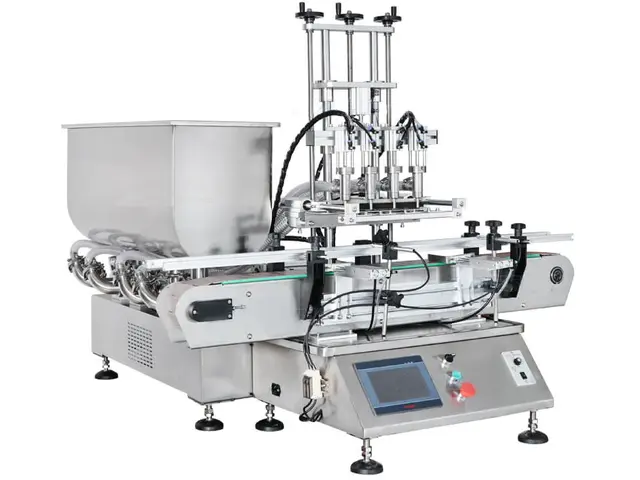
Tabletop 2–4 head piston filler for soaps, shampoos and viscous liquids. Accurate volumetric dosing with ≤±1% typical accuracy.
View details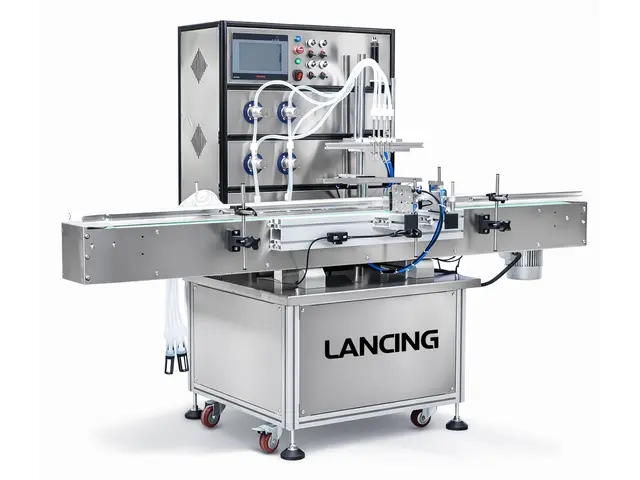
Liquid filling machines
Liquid filling machines configured for free-flowing, foamy, corrosive, hygienic or high-value liquids in bottles, vials, jerrycans and…
View details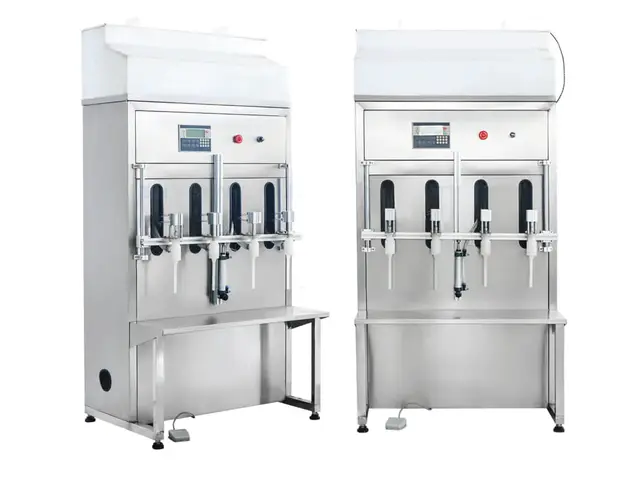
Automatic filling machines
Automatic gravity filler engineered for corrosive liquids like bleach, acids and fertilizers. Non‑metal wetted parts (PP/PTFE/PVC)…
View detailsApplication and acceptance guidance
This compact machine uses four independently driven peristaltic pumps with electric-eye container detection. The existing reference flow, accuracy and speed figures are based on stated conditions and must be tested at the required volume with the production liquid, tube, nozzle and bottle. The independent channels offer adjustment, but each channel also needs controlled setup and verification.
The short conveyor and compact envelope make the surrounding work pattern important. Define how bottles are loaded, spaced and removed, how caps are handled, where product vessels sit and how tubes are changed without obstructing controls or creating trip and spill risks.
Record tube and calibration for each pump. Confirm the electric eye starts the intended cycle and that gaps or a stopped bottle do not create repeat fills. Recheck every channel after tube replacement.
Test production bottles for height, neck alignment and stability on the compact belt. Include lightweight packs and the intended spacing from the operator or infeed device.
Provide safe locations for product sources, empty bottles, full bottles, caps and samples. The operator should not reach across moving equipment or pull on product tubes during normal work.
Specification and trial evidence
Assess both metering and the complete small-line operating rhythm.
| Selection point | What to define or test | Why it matters |
|---|---|---|
| Tube installation | Fit the approved tube and route without kinks or tension | Creates repeatable metering and source conditions. |
| Head calibration | Measure each nozzle at the required small and large fills | Confirms individual channel performance. |
| Sensor test | Run normal gaps, closely spaced bottles and a blocked outfeed | Checks no-bottle-no-fill and repeat-fill prevention. |
| Sustained run | Operate long enough to include product replenishment | Shows channel balance and realistic output. |
| Operator cycle | Load, remove, cap and inspect using the planned work cell | Identifies manual bottlenecks and access issues. |
| Tube change | Replace the path, prime and reapprove all channels | Measures practical hygienic or product changeover. |
Buyer questions
The channels are independently driven, so calibration should confirm each one. The operating recipe and tube identity should make the approved setup repeatable.
It may be adjusted within the stated machine window, subject to nozzle position, guides, sensor location and stability. Test each production format.
The recommended range on the page, tube and pump flow, cycle time, container and voltage configuration all need consideration. Confirm the exact requirement with Lancing.
Spacing must allow the sensor and filling sequence to identify each container without overlap. Use the actual pack and planned loading method during the trial.
The replaceable tube path can help isolate product, but connectors, nozzles, source vessels and the documented change procedure still need review.
Count accepted filled bottles after loading, sensing, filling, removal and any cap handling over an agreed period, and record stops or rejects.