
Product behaviour
Viscosity, foam, particles, temperature and chemical compatibility.
Selection and comparison guides
Drips and product strings can waste material, mark containers and slow cleaning. Shut-off, suck-back and bottom-up nozzle designs are often considered when liquids trail or foam.
Buyer intent guide
The best choice is rarely decided by one factor. A method that works well for a thin chemical may not suit a viscous food product, and a machine that is fast on one bottle format may slow down when changeovers are frequent.
Viscosity, foam, particles, temperature and chemical compatibility.
Bottle, jar, pail or jerrycan size, neck opening, stability and closure.
Fill volume or weight, accuracy tolerance and required bottles or packs per minute.
Manual loading, semi-automatic operation, compact automation or full inline production.
Specification notes
These points help make an enquiry more accurate and reduce the risk of selecting the wrong filling principle.
The same bottle filling machine can perform very differently when the liquid changes. A water-thin cleaner, a foaming detergent, a viscous sauce, a fragrance oil and a corrosive chemical each create different challenges. Product behaviour drives pump selection, nozzle design, materials and speed.
For a strong recommendation, include the product type, approximate viscosity, whether it foams or strings, whether it contains particles and whether it needs heating, mixing or special materials.
Filling speed should be balanced with capping, labelling, operator loading and packing. A fast filler does not improve the line if bottles cannot be presented, capped or labelled at the same rate.
For growing production, Lancing can discuss a sensible route from semi-automatic equipment to compact automation or a fully automatic filling line.
Relevant machinery
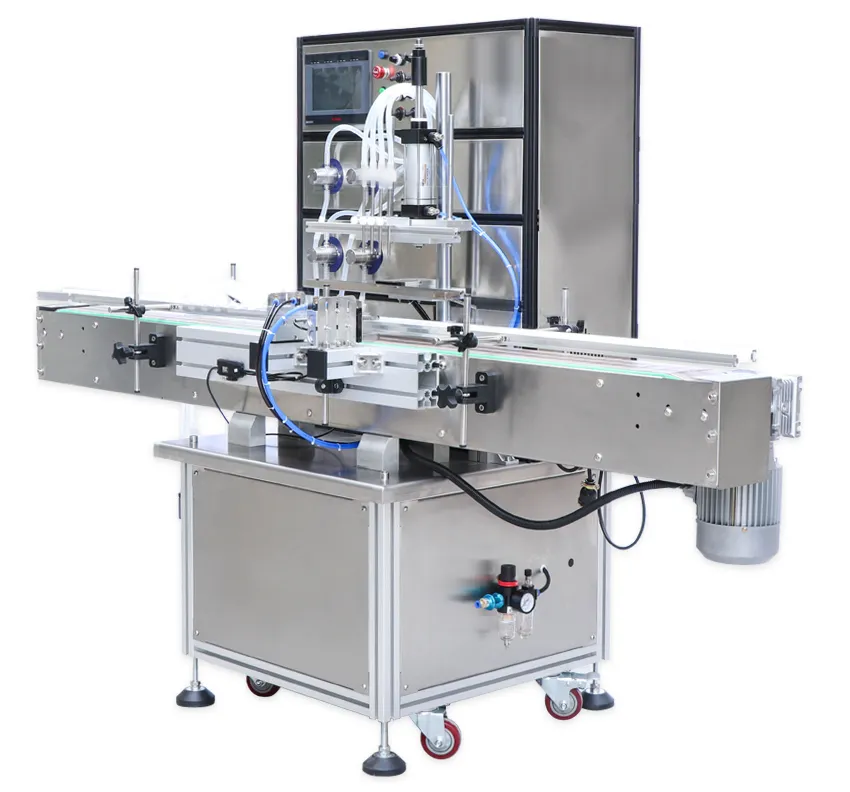
These product pages are useful starting points when discussing drip free liquid filling nozzles.
Relevant Lancing machinery to discuss when specifying drip free liquid filling nozzles projects.
View productRelevant Lancing machinery to discuss when specifying drip free liquid filling nozzles projects.
View productRelevant Lancing machinery to discuss when specifying drip free liquid filling nozzles projects.
View productRelevant Lancing machinery to discuss when specifying drip free liquid filling nozzles projects.
View productFAQs
Residual hose pressure, gravity, product elasticity, valve leakage or a string on the tip can continue to release product after the metering action stops. Observe the nozzle immediately after shut-off and during a pause before choosing a different shut-off, suck-back or motion sequence.
Trial the actual liquid and production container over repeated fills, planned stops and restarts. Record product on the neck, shoulder or outside wall as well as delivered quantity, and assess shut-off quality, particle clearance and cleaning access together.
Provide the product behaviour and particle range, required flow and dose, smallest neck opening, container variation and proposed nozzle movement. Check the narrowest passage through the complete product path; a larger outlet cannot correct a smaller restriction upstream.
Need a recommendation?
Lancing will recommend a suitable semi-automatic, compact or fully automatic filling solution.